All hail the “const” parameters!
Passing parameters as “const” is a classic Delphi optimization trick, but the mechanisms behind that “trick” go beyond cargo-cult recipes, and may actually stumble into the “good practice” territory.

Passing parameters as “const” is a classic Delphi optimization trick, but the mechanisms behind that “trick” go beyond cargo-cult recipes, and may actually stumble into the “good practice” territory.
Hot on the heels of Nick Hodges being suddenly “let go“, Borcodero guys engaged in a bout of pathetic self-deprecating PR disaster.
Apparently along with Nick, more than a Spirit of Delphi award winner may have left Embarcadero.
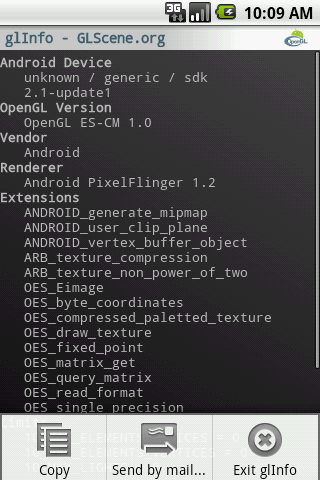 Just published glInfo in the Android Market, this is a simple utility that provides information on the OpenGL ES driver of the device it’s running on (version, supported extensions, limits…) and allows to copy or mail the whole report.
Its purpose is to facilitate gathering device OpenGL ES support information, when the device you’re targeting or have issues with is in the hands of a non-developer… or in the hands of a lazy developer 😉
It is named after from the glInfo utility that used to be hosted at Tom Nuydens’s Delphi3d site.
I’ve updated the GLScene.org main page with information on where you can find support newsgroups and forums, since the nntp newsgroup went down and are unlikely to come back up (thanks Paul Van Dinther, now from PlanetInAction, for the help in accessing the wiki).
A recurring subject when it comes to freeing objects and preventing is whether you should just .Free them, thus leaving a invalid reference that should however never be used anymore when the code design is correct, or if you should defensively FreeAndNil() them, thus leaving a nil value that will hopefully trigger AVs more often on improper usage after release.
SamplingProfiler v1.7.4 is now available. This version adds an option for Delphi 2010 paths, and fixes a bug with the silent mode execution that would render it inoperative. There also have been other minor changes, mostly cosmetic.
This release also includes preparation for an “attach to process” option, which is currently not enabled, but should hopefully make in the next version (available “when ready”).
An improved version of ZJDBGPack has been released, with better error messages and non-zero exit codes when an error occurs. This makes it more usable for batches and automated builds.
SamplingProfiler has a few options to help profile a multi-threaded application which I’ll go over here.
In the current version, those options allow identifying CPU-related bottlenecks, as in “threads taking too much CPU resources or execution time”. However, they do not provide much clues yet to pinpoint bottlenecks arising from thread synchronization issues or serialization (insufficient parallelism). Hopefully, more support for profiling multi-threaded applications will come in future versions.
SamplingProfiler v1.7.3 has now been released and should be used in place of 1.7.2 which was pulled.
1.7.2 had a nasty bug in the timings statistics (promptly spotted by Robert Houdart) which should be fixed in 1.7.3, there are no other changes and additions in this version.
SamplingProfiler v1.7.2 has now been released.
This version includes the following changes:
The UI has been slightly rearrange to accomodate the CPU affinity options (I guess I’ll need to find something prettier for those upcoming 256 core CPUs…). There may be other indirect minor changes.